In a TEDx Talk she gave in 2022, Annie Ray, an orchestra director and advocate for inclusive music education, invites us to rethink what success in music, and in education more broadly, looks like. She challenges traditional metrics — perfect technique, flawless performance — and offers instead a vision rooted in access, voice, growth, and connection. Here are some key themes from her message.
1. Meet students where they are

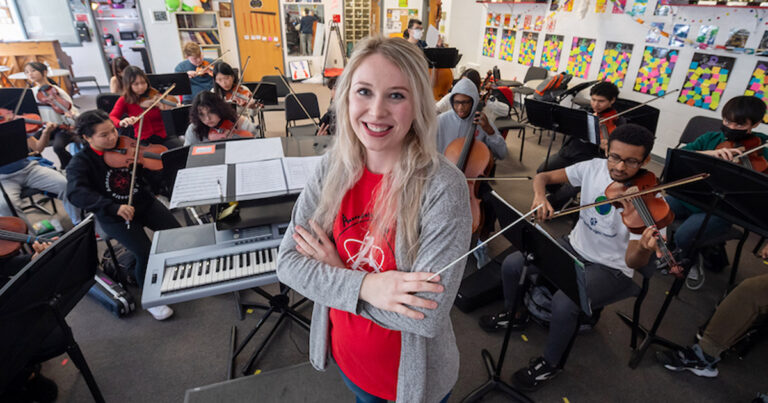
Ray emphasizes that all students deserve real music-education opportunities — not just as an add-on, but as meaningful participation. In her program at Fairfax County Public Schools, for example, she created the “Crescendo Orchestra” for high-school students with significant developmental or intellectual disabilities.
The message: don’t wait for “readiness” according to the usual standard; adapt the path to the learner.
2. Redefine the learning destination

Rather than success = “no mistakes,” Ray defines success in music as showing up, making sound, taking risks, progressively improving, and being included. As she said in an interview with CBS, “You must be willing to make “bad sounds” before making good ones.
This means valuing process over polish: the smile, the interaction, the curiosity — not just “can you play a 5-note melody perfectly?”
3. Inclusion isn’t just a word — it’s a practical shift

Ray shows how making inclusion real isn’t about lowering standards, but adapting methods: color-coded strings, movement scarves, cardboard instruments, differentiated pacing. For example, a student who struggles verbally may still engage with rhythm, ensemble, or oral/aural music interaction. The teacher’s role is to find what the student can do and build from there.
4. Community & culture matter

One of Ray’s inspiring points is that when students bring their culture, their voice, their identity into the music room, everyone is enriched. In an interview with PBS, she describes students who speak another language at home and musicianship learned “by ear” rather than by strict notation — and how those strengths become assets.
A closing thought & invitation
Annie Ray’s talk reminds us: Music education isn’t just about creating tomorrow’s virtuoso; it’s about providing voice, belonging, self-expression, and community today, for every child, every family, every teacher.
If you’ve ever wondered what it might feel like to explore singing or instrument lessons — whether for yourself or your child — we invite you to come in and talk with us. We’ll help you:
🥁 Pick a musical path that you are excited about (voice, guitar, trumpet, violin, etc.).
💡 Connect with a teacher who doesn’t just teach technique — they inspire connection.
At Canal Fulton Music, we’re not only teaching music; we’re helping musicians find their voice.
Ready to explore? Learn more about lessons below.